This is part 2 of a series that began with What investors should know about data centers’ social risks. There, we compared investor considerations for social license to operate between data centers and other types of significant land-use projects, and we clarified how to think about costs of community conflict and Social-Risk-Adjusted Net Present Value. Here, we turn to when engagement should begin, and to the quality signals investors should look for in data center developers, operators, owners, or tenants.
Defining “early” engagement with more precision
JF. “Early” engagement has become the standard prescription for data center social risk: it is said to strengthen community acceptance, reduce permitting risk, support future expansion and build trust. How should investors define “early” engagement for a greenfield site, a brownfield redevelopment, and an expansion at an operating facility? And does the answer change with the market constraint profile of the location? The table below sets out six profiles to consider.
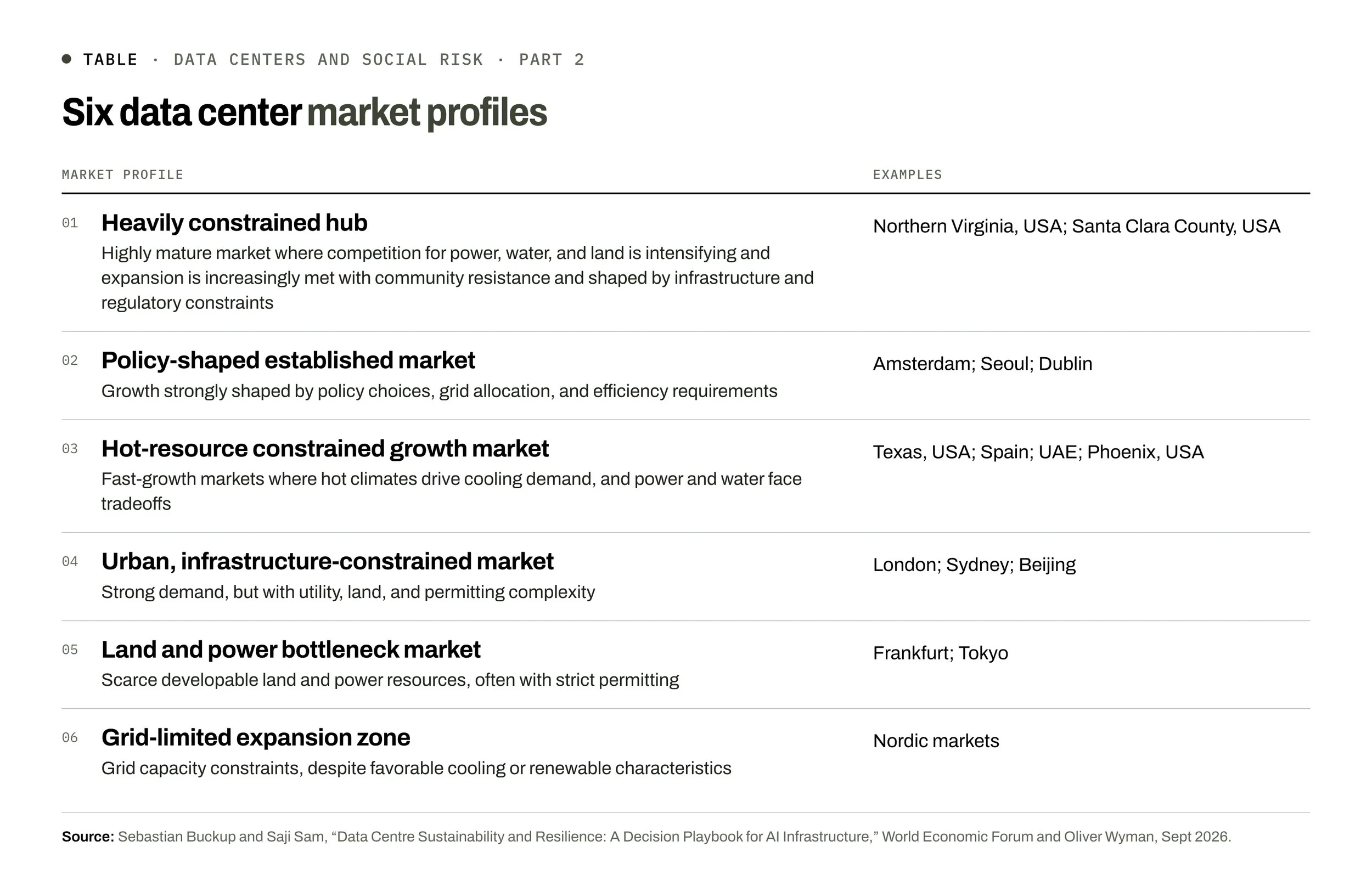
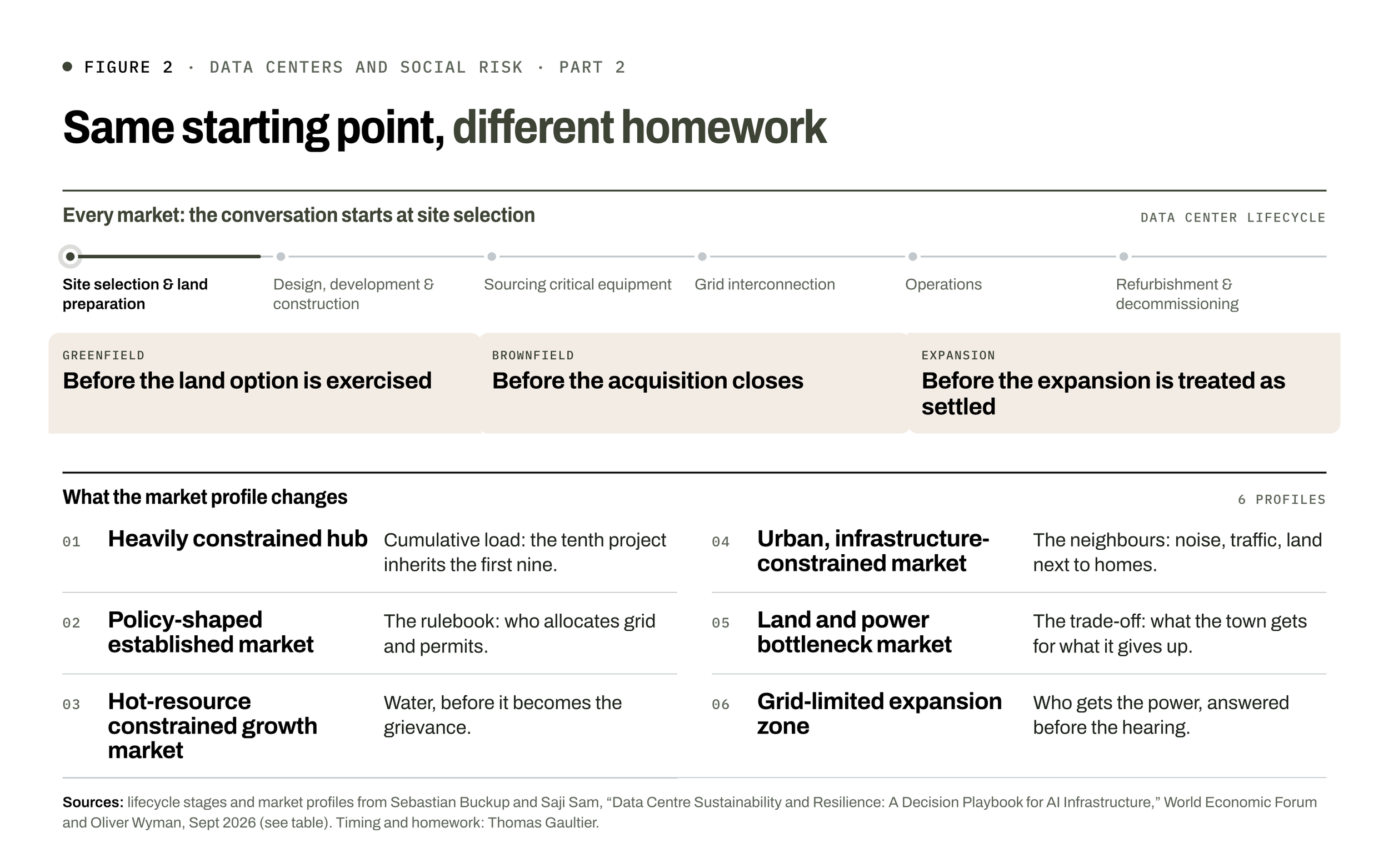
TG. “Early” means before positions exist. The cheapest agreement is the one designed before the ground breaks, and the same agreement costs more at every later stage. What changes between the three cases is the moment that counts as “before.”
Greenfield: before the land option is exercised. If the community learns of the project from a planning notice, it is already late. The marker I check is whether the water source and the power route were still open questions when the first conversations happened.
Brownfield: before the acquisition closes. A site carries its history whether or not the new owner caused it. I have seen a buyer learn eighteen months after a deal that the community had fifteen years of documented complaints the data room never showed. The most predictive indicator of post-acquisition trouble was not in any data room. It was the quality of the seller’s relationships with the people next door. So for a redevelopment, early means a commitment register built before signing: every promise the previous operator made, kept or not.
Expansion: before the expansion is treated as settled. Consent to the first building is not consent to the second, or to the new substation, or to the water draw doubling. Operating sites skip this because they assume the relationship carries. It does, if there is a review clause and the company uses it. Mining agreements that hold reopen for exactly these events: expansion, change of ownership, change of law.[1]
The market profile changes the homework, not the starting point. In a constrained hub like Northern Virginia the issue is cumulative. The tenth data center inherits the resentment built by the first nine, as the tenth mine in a district does. In a hot-resource market the fight is water, the one issue mining never managed to mitigate once it had become the grievance. Conga in Peru was stopped by water protests that no environmental approval could answer, and a 4.8 billion dollar asset was written to zero. In a grid-limited zone the question is who gets the power, and the project needs an answer before the hearing, not a study after it. In a growth market the project may be the first of its kind and gets to shape expectations, a gift most developers waste by over-promising jobs.
So: same starting point, different homework.[2]
Quality of community engagement
JF. How can investors assess the quality of community engagement at a facility level? At a portfolio level?
TG. At the facility, count outcomes, not meetings. “Forty-seven community meetings” tells me nothing. I want three things. The last operational change made because of something the community said. The grievance log, with time to resolution and repeat rate. And who was in the room. A participant list that mirrors the council and a session with no dissent is elite capture. A room that signs the register and empties by mid-morning was paid to come.
Two numbers from the field to calibrate. Zero grievances in an active project area is a red flag, not a success. And when a mechanism starts working, intake rises for two years before it falls, so expect the cure to look like deterioration.
At the portfolio level, the question is whether anyone at the top can see this. This is one place where the type of investor matters: a lender or a private owner can make the numbers below a condition of the money, a shareholder can only ask the board whether it receives them. Does the board get the repeat-grievance rate and the top three recurring issues by site, or does it get a slide with the number of meetings held? Does the social performance budget survive a cost review? And the question I ask every board: if the three people who hold the community relationships left tomorrow, what would remain? If the answer is nothing, the portfolio has relationships, not a system.[3]
JF. What are the quality signals to examine when a community benefits framework is part of the negotiation between a project developer or sponsor and the community? This can be a complex assessment for investors, since there are several kinds of binding and non-binding frameworks, which go by different names such as Community Benefits Agreement (CBA), Host Community Agreement, Good Neighbor Agreement, Cost Recovery Agreement, etc.
TG. The name on the cover matters less than four things inside.
Is it binding? “Shall,” not “endeavour to.” For every commitment, three tests: is it mandatory, is it measurable, and is there a consequence for failure? An agreement that fails those is a memorandum of understanding with a nicer title.
Can the community monitor it? I have watched a 140-page agreement die within twelve months: one hundred and forty pages of what, zero pages of how. A two-hundred-page agreement is worthless to a community that cannot monitor page nine. Look for a joint committee with real powers: access to data, site access, and the right to commission independent verification at the company’s cost. Its budget should not flow through the department it oversees.
Does it travel? Expansion, change of ownership and change of law should each reopen the relevant terms. And a succession clause should bind whoever buys the site next. Data centers change hands; an agreement that dies at the sale was never worth much.
Is it benefit or compensation? Money spent is gone. A restored livelihood, a training pipeline, a share of the value that keeps producing, those hold. Cash-only deals buy short-term peace and long-term grievance.
One more, which investors can check from outside: was the community advised independently? An agreement negotiated without independent advice will be challenged. New York’s new framework puts a price per megawatt on the deal. It says nothing about how the two sides get to it, and that is where most agreements fail.[4]
Looking ahead
TG. Everything above was learned the expensive way in mining. The data center sector has the chance to skip that tuition, because it is arriving at the problem with thirty years of the extractive sector’s case law already written.
JF. Data centers sit at the center of today’s most important economic trends but also some of the most contentious social and cultural dynamics. Investors seeking a disciplined approach to AI exposure should be checking their stewardship and communication approaches.

Thomas Gaultier is a mediator and international commercial legal consultant who designs agreements between industrial projects and the communities around them. He has mediated more than 2,000 community and historic claims in Mozambique. He is the author of Social Accord Architecture and nine companion volumes on mediation, social risk and community agreements, and he teaches negotiation at Universidade Católica Portuguesa and law at Forward College in Lisbon.

Jordan Famularo PhD is principal of Glyptique Consulting, an advisory partner helping investors in the AI value chain translate reputational, regulatory, and ESG signals into clear stewardship and communication strategies. She is author of peer-reviewed articles in the International Journal of Corporate Social Responsibility (now Journal of Sustainable Business) and Telecommunications Policy. Formerly, she worked in the global sustainability group at SEMI and was a postdoctoral scholar at the Center for Long-Term Cybersecurity.
October 27, 2026
Endnotes
[1] Thomas Gaultier, Social Accord Architecture: The Methodology for Building Durable Agreements Between Industrial Projects and Communities (2026), ch. 1, §1.2; ch. 2, §2.3; ch. 11, §11.5; Thomas Gaultier, Legacy Grievances and Historical Claims: A Guide to Post-Operational Dispute Resolution (2026), ch. 3; Thomas Gaultier, When the Mine Arrives: An Insider’s Guide for Communities Negotiating with Extractive Industries (2026), ch. 13, §13.1.
[2] Thomas Gaultier, Social Risk for Boards: An Executive Handbook on Social Risk Governance (2026), ch. 4 (Conga); Thomas Gaultier, Social Accord Architecture: The Methodology for Building Durable Agreements Between Industrial Projects and Communities (2026), ch. 1, §1.2; Thomas Gaultier, Standing in the Middle: 100 Field Practices for Mediating Between Mines and Communities (2026), practice 34.
[3] Thomas Gaultier, Social Risk for Boards: An Executive Handbook on Social Risk Governance (2026), ch. 5, §5.1; ch. 6, §6.4; ch. 8; Thomas Gaultier, Grievance Mechanisms That Work: Designing and Operating Effective Non-Judicial Remedies (2026), ch. 3; ch. 8, table 8.1; appendix F; Thomas Gaultier, Social Accord Architecture: The Methodology for Building Durable Agreements Between Industrial Projects and Communities (2026), ch. 1, §1.6.
[4] Thomas Gaultier, When the Mine Arrives: An Insider’s Guide for Communities Negotiating with Extractive Industries (2026), ch. 8, §8.3; ch. 9; ch. 11, §11.1; ch. 13, §13.2; Thomas Gaultier, Social Accord Architecture: The Methodology for Building Durable Agreements Between Industrial Projects and Communities (2026), ch. 5, §5.1; ch. 6, §6.3; ch. 11, §§11.7–11.8; Thomas Gaultier, Standing in the Middle: 100 Field Practices for Mediating Between Mines and Communities (2026), practice 36; Thomas Gaultier, Legacy Grievances and Historical Claims: A Guide to Post-Operational Dispute Resolution (2026), ch. 8.

Image credit: Ahmet Yüksek, Unsplash.