For investors seeking exposure to the long-term growth of the digital economy, the stakeholder politics of data centers is becoming increasingly vital. A “toxic brand”[1] is affecting the global data center sector, while local opposition has become what The New York Times called “the most bipartisan issue since beer.”[2] Community resistance is changing risk dynamics for equity and fixed-income investors. Whether a data center project can be delivered and how much execution risk its developer carries are now essential questions along with how demand for digital infrastructure will evolve.
Yet investors are grappling with how to understand social license to operate for companies participating in the digital infrastructure build-out. Social friction is affecting data center project economics through asset impairment, operating costs, revenue loss, credit-relevant risks, and cost of capital, particularly for U.S. assets.[3] Corporate community engagement, once disparaged as a cost center that merely does philanthropy or communications, is now seen more clearly to mitigate material financial risk.
To decode the most weighty issues for investors — and give them a window onto diligence and oversight for social risk in the digital infrastructure landscape — we teamed up to transfer cutting-edge learnings from the extractives and energy sectors. Like data centers, these sectors anchor to physical infrastructure that enters social landscapes, affecting livelihoods, land use, ecosystems, economies, and ways of life. But investors must navigate where analogies hold up and break down between digital infrastructure, mining, and energy.
Thomas Gaultier is a mediator and international commercial legal consultant who designs agreements between industrial projects and the communities around them. He has mediated more than 2,000 community and historic claims in Mozambique. He is the author of Social Accord Architecture and nine companion volumes on mediation, social risk and community agreements, and he teaches negotiation at Universidade Católica Portuguesa and law at Forward College in Lisbon.
Jordan Famularo PhD is principal of Glyptique Consulting, an advisory partner helping investors in the AI value chain translate reputational, regulatory, and ESG signals into clear stewardship and communication strategies. She is author of peer-reviewed articles in the International Journal of Corporate Social Responsibility (now Journal of Sustainable Business) and Telecommunications Policy. Formerly, she worked in the global sustainability group at SEMI and was a postdoctoral scholar at the Center for Long-Term Cybersecurity.
Apples to apples, or apples to oranges? Data centers and other large-scale infrastructure projects
JF. Data center projects share certain environmental and social factors with other kinds of large-scale infrastructure projects. Land use, labor, air quality, water use, and energy mix are some of the decision areas that shape community acceptance, conditioning, or rejection of a project. What are the most significant transferable learnings from other sectors that you see as supporting investor due diligence?
TG. Three things travel without modification.
First, acceptance is a relationship, and a relationship can be audited. In mining, lenders have learned to ask for the engagement plan with the same seriousness as the mine plan. The question I put to any project is simple. Can someone show me the engagement design as a document? Can they tell me the state of the key relationships with evidence a banker would accept? Projects that can answer are running a process. The rest are running on luck.
Second, the first fight is almost never about the big thing. It is about jobs that were hinted at and never materialised, or dust, noise, and traffic that accumulate into resentment faster than any single incident. A data center promises few permanent jobs and a lot of construction traffic, so expect the same pattern, compressed.
Third, silence is not consent. The most dangerous sentence I hear on a site is “our grievance numbers are low.” A busy complaints log with fast closure and few repeats is a healthy site. A quiet one is a site where people have stopped talking to you.
The diligence question that follows from all three: show me your grievance log, and show me the last operational change you made because of it.[4]
JF. Data centers have been called out as distinctive from other significant land-use projects because the pace of development is so frenetic, putting pressure on the time available to communicate with local stakeholders. How do investors know if a project’s plans allow sufficient time for meaningful community engagement?
TG. I would turn the question around. Trust does not compress to fit a Gantt chart. The fast process is usually the slow one in disguise. I have seen a consultation cut from six months to six weeks to clear a financing milestone. Eighteen months later the agreement was disowned as coerced and the access road was blocked.
So the test is not whether the schedule has a line called “community engagement.” It is whether that line sits before the design is frozen. The tell I look for is a draft that survives every workshop unchanged. If the site plan, the water source, and the traffic routing were decided before the first public meeting, the meeting is an announcement, whatever it is called.
For a data center, my working view is that the mining sequence does not shrink, it moves earlier. A mine has years of exploration during which the community gets used to the idea. A data center has none, so the agreement has to be designed during site selection and permitting, or it does not get designed at all. An investor can check one thing: when the land option was signed, had anyone from the project sat in a kitchen in that town yet?[5]
JF. Besides pace of development, are there breakdowns in analogies between data centers and other types of significant land-use projects that investors should know when assessing risks or opportunities linked to social license to operate?
TG. Two places, and they pull in opposite directions.
The first break favors data centers. A mine changes the land permanently and leaves a hole, a dam and a town that depended on it. A data center is a building with a fence. There is no resettlement, no tailings, no closure fight twenty years out. Most of the heavy artillery in my field, legacy claims and historical grievances, does not apply.
The second break goes the other way. A mine has a long courtship. Exploration can run two to ten years, feasibility one to three, and the community’s leverage peaks in that window, before permits and financial close. That is where the agreements get negotiated, badly or well. A data center skips the courtship. The community meets the project at the permit hearing with the design already done, and its only leverage is to say no. That is why the opposition is so blunt. It has no other instrument.
And one thing that does not break, which people assume does: who speaks for the community. A county board is not the neighbors. In mining we learned that legitimate representation braids elected, traditional, and newer voices, and that a deal with the wrong leaders buys a blockade later. A data center that negotiates only with the county has made the same mistake with a shorter fuse.[6]
Write-downs and costs
JF. You have written about research demonstrating that social conflict can destroy 24-37% of a project’s Net Present Value when land and other resources are contested.[7] Is it possible to quantify a Social-Risk-Adjusted Net Present Value for data centers?
TG. Yes, and the arithmetic is the easy part. The model only adds two inputs to a normal NPV: the probability of disruption, and the money spent to lower it. In Social Risk for Boards I work a copper example where the traditional NPV is 341 million, the risk-adjusted figure without mitigation is 127 million, and with mitigation 274 million.[8] The social spend protected 147 million, roughly 2.16 dollars back for every dollar in. My rule of thumb from the field is that about 2 percent of initial NPV spent on prevention avoids about four times that in losses.
The hard part for data centers is the disruption probability, because there is no twenty-year dataset of blocked projects to calibrate it. I would build it from three observable things. Were the water and power questions answered before the hearing? Does the project have a working grievance channel? And are the people the project talks to the people who can stop it?
One caveat on the investor type. A project finance lender can require this calculation as a condition. A public equity holder can only ask the board whether it exists, and the absence of an answer is itself the data point.[9]
JF. How are the costs of community opposition to data center projects obscured for investors?
My view on this question is, investors typically have limited visibility because the costs are hidden structurally by how they are tracked and reported by companies. At the corporate level, costs are spread across functions – legal, communications, development, finance – but there is no comprehensive view of cumulative costs because they are not linked to community conflict as a root cause. At the site level, conflicts are often tracked, but then they are not linked to financial performance in any systematic way that investors can uncover. We’ve seen this in the renewable energy sector, for which a 2026 report by the Institute for Human Rights and Business documented these problems with investor visibility.[10]
Thomas, anything to add?
TG. Jordan has the structural point right, so I will add what it looks like from inside. Conflict books itself into accounts a finance team already knows how to read. It just never carries the label. Haulage sits idle on day rates. The contractor demobilizes and remobilizes at the company’s cost. Security overtime triples in a week. Each of those lines has an owner, and none of the owners calls it “community conflict.”
The other reason is that the biggest cost is an absence. In a worked example I use, a three-week road blockade cost about 4 million in lost production and under a million in security and legal. The expansion permit that slipped six months because of it cost 15 million. Nobody writes a purchase order for a permit that did not arrive.
For data centers I would watch two costs that mining taught us to underprice. Staff time, which in some cases takes a third to a half of an asset manager’s working life. And the next project not approved, because a public fight in one county is read by every other county on the shortlist.[11]
JF. Let’s consider the well-known matrix of costs resulting from conflict between local communities and the extractive sector, published by Davis and Franks. Which of these cost types need highlighting for investors in data centers because they are overlooked or underappreciated?
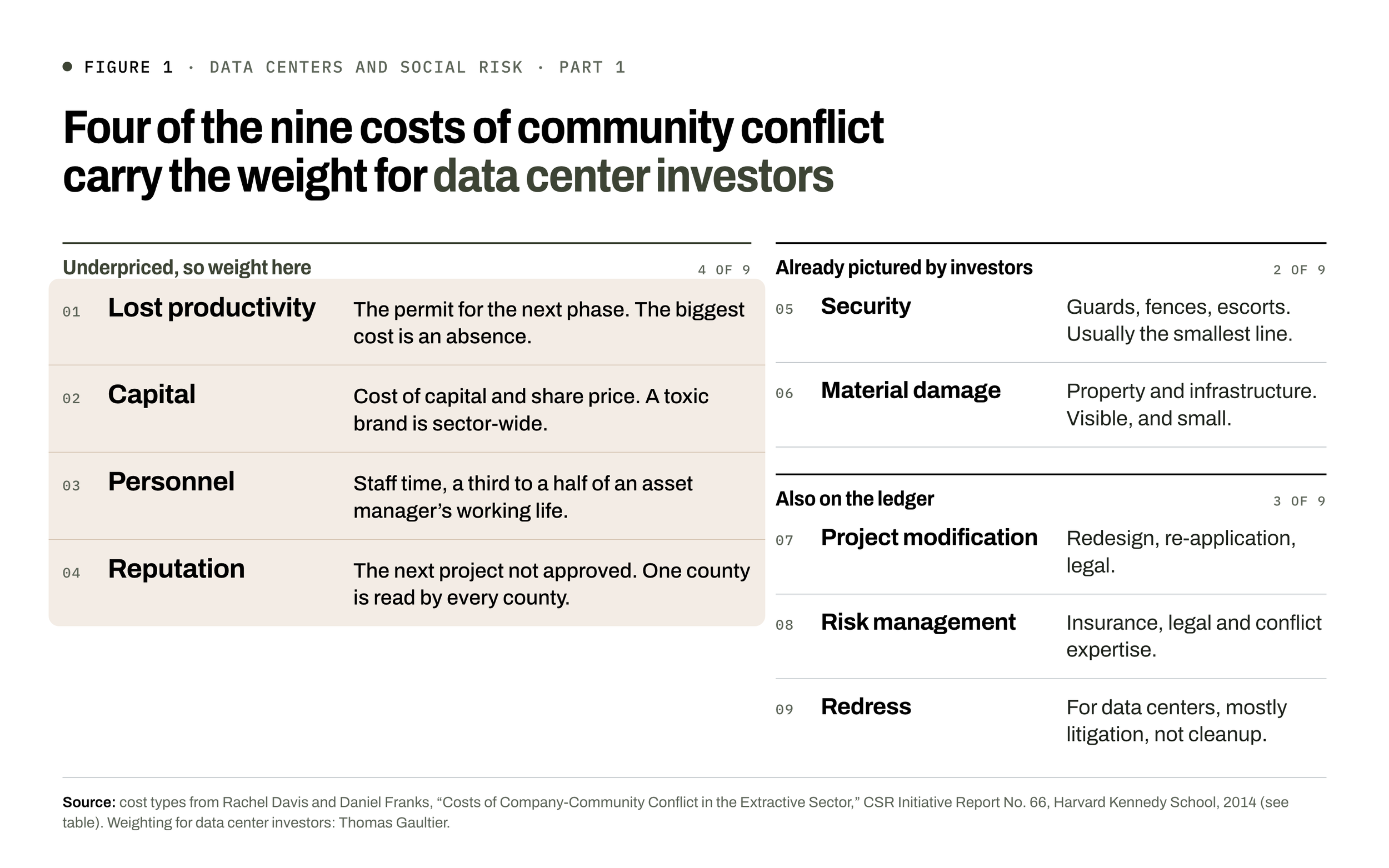
TG. For investors I would put the weight on four rows. Lost productivity (the permit for the next phase), Capital (cost of capital and share price, because a toxic brand is sector-wide), Personnel (staff time) and Reputation. Security and Material damage are the rows investors already picture and are usually the smallest. For Redress, data center costs are mostly litigation costs, not cleanup.
JF. Thanks. Having looked at costs of conflict, let’s consider how investors can assess what companies do to prevent and mitigate them. In part 2 of this series — When data centers should begin community engagement, and how to judge its quality — we outline the quality signals that investors should examine when assessing community engagement by data center developers, operators, owners, or tenants.
Looking ahead
TG. Everything above was learned the expensive way in mining. The data center sector has the chance to skip that tuition, because it is arriving at the problem with thirty years of the extractive sector’s case law already written.
JF. Data centers sit at the center of today’s most important economic trends but also some of the most contentious social and cultural dynamics. Investors seeking a disciplined approach to AI exposure should be checking their stewardship and communication approaches.

Thomas Gaultier is a mediator and international commercial legal consultant who designs agreements between industrial projects and the communities around them. He has mediated more than 2,000 community and historic claims in Mozambique. He is the author of Social Accord Architecture and nine companion volumes on mediation, social risk and community agreements, and he teaches negotiation at Universidade Católica Portuguesa and law at Forward College in Lisbon.

Jordan Famularo PhD is principal of Glyptique Consulting, an advisory partner helping investors in the AI value chain translate reputational, regulatory, and ESG signals into clear stewardship and communication strategies. She is author of peer-reviewed articles in the International Journal of Corporate Social Responsibility (now Journal of Sustainable Business) and Telecommunications Policy. Formerly, she worked in the global sustainability group at SEMI and was a postdoctoral scholar at the Center for Long-Term Cybersecurity.
October 27, 2026
Endnotes
[1] National Republican Senatorial Committee, Letter on Ohio Data Center Risk (Aug. 18, 2026), published in Alex Isenstadt, “Exclusive: GOP Issues Stark Warning to AI Companies,” Axios (Aug. 19, 2026), https://www.axios.com/2026/08/19/gop-data-center-memo-ai-election.
[2] Sabrina Tavernise, “‘The Most Bipartisan Issue Since Beer’: Opposition to Data Centers,” The New York Times (May 1, 2026).
[3] See e.g., Sridhar Natarajan, Brody Ford, and Paula Seligson, “Oracle Cites ‘Force Majeure’ to Shield Itself on Controversial Data Center,” Bloomberg (Sept. 24, 2026), https://www.bloomberg.com/news/articles/2026-09-24/oracle-cites-force-majeure-to-shield-itself-on-controversial-data-center; Theresa Agovino, “When Data Center Development Meets Community and Government Backlash,” PERE (Aug. 24, 2026), https://www.pei-privaterealestate.com/equity/when-data-center-development-meets-community-and-government-backlash/; Prasad Tamminaina and Atanas Delevski, “More Power, Less Cushion: AI and the Changing Credit Risk Profile of Data Centers,” S&P Global (July 20, 2026), https://www.spglobal.com/market-intelligence/en/news-insights/research/2026/07/more-power-less-cushion-ai-and-the-changing-credit-risk-profile-of-data-centers.
[4] Thomas Gaultier, Social Accord Architecture: The Methodology for Building Durable Agreements Between Industrial Projects and Communities (2026), ch. 1, §§1.5–1.6; Thomas Gaultier, Standing in the Middle: 100 Field Practices for Mediating Between Mines and Communities (2026), practices 34 and 73; Thomas Gaultier, Grievance Mechanisms That Work: Designing and Operating Effective Non-Judicial Remedies (2026), ch. 2 and ch. 8.
[5] Thomas Gaultier, Standing in the Middle: 100 Field Practices for Mediating Between Mines and Communities (2026), practices 40 and 47; Thomas Gaultier, Grievance Mechanisms That Work: Designing and Operating Effective Non-Judicial Remedies (2026), ch. 3 and appendix E; Thomas Gaultier, Navigating Human Rights Due Diligence: A Compliance-to-Engagement Implementation Guide (2026), ch. 4.
[6] Thomas Gaultier, When the Mine Arrives: An Insider’s Guide for Communities Negotiating with Extractive Industries (2026), ch. 1, §1.4, table 1.2; Thomas Gaultier, Social Accord Architecture: The Methodology for Building Durable Agreements Between Industrial Projects and Communities (2026), ch. 11, §11.2; Thomas Gaultier, The Human Shock Absorber: A Survival Guide for Community Relations Practitioners (2026), ch. 3.
[7] Joseph Feyertag and Ben Bowie, “The Financial Costs of Mitigating Social Risks: Costs and Effectiveness of Risk Mitigation Strategies for Emerging Markets,” Overseas Development Institute (ODI) (Sept. 2021), www.econstor.eu/bitstream/10419/28086/1/1813097518.pdf
[8] Thomas Gaultier, Social Risk for Boards: An Executive Handbook on Social Risk Governance (2026), ch. 4, §4.4, table 4, p. 104.
[9] Thomas Gaultier, Social Risk for Boards: An Executive Handbook on Social Risk Governance (2026), ch. 4, §§4.2 and 4.6; Thomas Gaultier, Social Accord Architecture: The Methodology for Building Durable Agreements Between Industrial Projects and Communities (2026), ch. 1, §1.2.
[10] Institute for Human Rights and Business, “The Hidden Bill of Green Conflict: Derisking Renewable Energy by Strengthening Community Trust,” (Apr. 29, 2026), https://www.ihrb.org/resources/the-hidden-bill-of-green-conflict
[11] Thomas Gaultier, Grievance Mechanisms That Work: Designing and Operating Effective Non-Judicial Remedies (2026), ch. 2, tables 2.1–2.2; Thomas Gaultier, Social Accord Architecture: The Methodology for Building Durable Agreements Between Industrial Projects and Communities (2026), ch. 1, §1.2, citing Davis and Franks (2014).
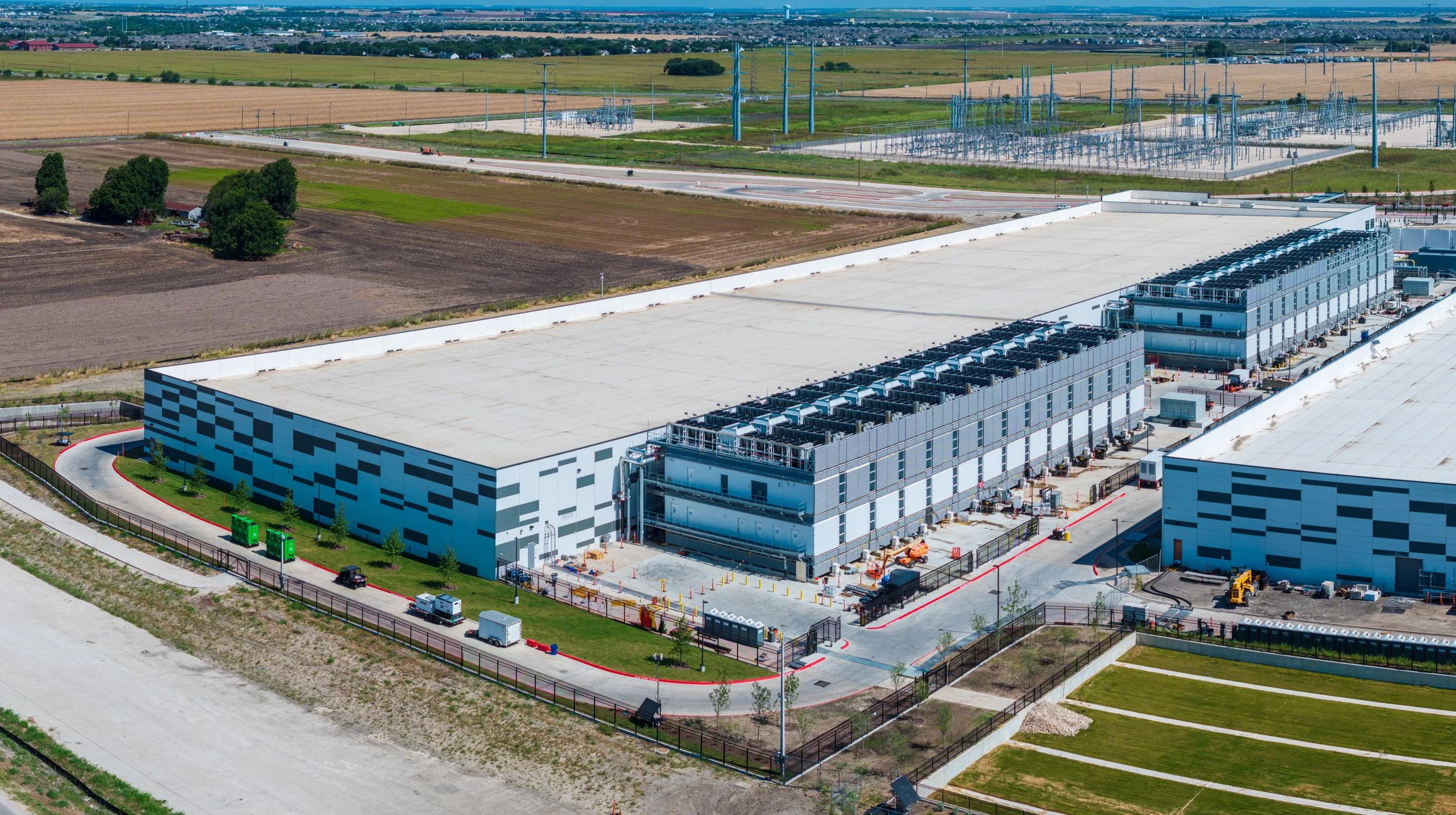
A data center and its power infrastructure meet farmland in Hutto, Texas, USA. 2026. Image credit: BackyardProduction.